Friday, August 8, 2014

School's Almost Back!!!

It's almost that time again! Back to school... Roughly 12 more days until I get to meet my 4th graders. I'm very happy to be teaching 4th grade math again this year. I'm busy making decorations and supplies for my classroom. Can't wait to start setting up my classroom. I will post the pictures of the progression of my classroom setup sometime next week!

On to other matters. This year, in an attempt to keep my desk organized and clutter free, I've been looking for desk trays/organizers. I found a pretty nice one...  the Seville Mesh Desk Organizer. At Costco this organizer is $16.99, but I'll do you one better! I found this organizer on Amazon for $9.99,  free shipping! This was such a steal, I had to buy 2!


Tuesday, March 4, 2014

Geometry Unit --- Polygons

Students learned about Polygons this week. We will expand later this week on Quadrilaterals (4 sided polygons). We even watched a cute song about Polygons.


Students learned that a polygon was a shape/figure that has straight sides (line segments), closed sides, 3 or more sides and is 2 dimensional (flat). Students learned about the different types of polygons:


Geometry Unit --- Points, Lines, Angles

Points, Lines and Angles
Students started our geometry unit learning about points, lines and angles. Students made foldables in class that were glued into their math journals.


 Students also learned how to name angles. An angle can be named by using a capitalized letter to represent it or 3 capitalized letters as seen below:

Tuesday, February 4, 2014

Ordering Fractions

Students learned how to use same denominator and same numerator to compare and order fractions. If a fraction has the same denominators, just look at the numerator. The smaller the numerator, the smaller the fraction. If a fraction has the same numerators, just look at the denominators, the smaller the denominator the bigger the fraction. Students also learned how to find equivalent fractions with common denominators to compare and order fractions more easily. We watched the following video to help better understand how to order fractions:

Sunday, February 2, 2014

Equivalent Fractions, Simplifying/Reducing Fractions & Converting Fractions

Equivalent Fractions
Students learned how to generate equivalent fractions. In order to make equivalent fractions you can multiply or divide the numerator and denominator by the same number.


Example:


Another method students learned to determine if fractions were equivalent is the butterfly method. Using the butterfly method, you could cross multiply and if the two products were equal, the fractions are equivalent.


Simplifying or Reducing Fractions
Students learned how to simplify or reduce fractions. When we simplify or reduce a fraction we use division to make the fraction smaller. When reducing fractions, students had to make sure that the numerator and the denominator was divided by a common factor.


Simplest form --- the smallest number a fraction can be reduced to. In order to find the simplest form of a fraction, you have to find the Greatest Common Factor (GCF) then divide both numerator and denominator by the GCF.


Converting Fractions
Students learned 2 methods to convert fractions --- TX method and division.


In order to convert Mixed Numbers to Improper Fractions, you would use the TX method. First, multiply the whole number with the denominator. If you have 4 wholes that are split into 4 equal parts (fourths) then you'd have 16 fourths. Then add the numerator... 16 + 3 = 19. You now have 19 fourths. We keep the same denominator so the improper fraction is 19/4.

In order to convert Improper Fractions to Mixed Numbers, you would use division. If I had 19/4 and I wanted to change that into a Mixed Number I would divide my numerator (top #) by my denominator (bottom #). 19 divided by 4 equals 4 with a remainder of 3. The 4 is my whole number and the remainder is the numerator of my fractions. We keep the same denominator so my mixed number is 4 and 3/4.
Fractions can be very difficult to master because there are so many aspects to it. Please continue to work with your child at home to ensure that he/she is comprehending the material. Thank you! --- Ms. Cao


Tuesday, January 7, 2014

Fractions --- Reviewing the Basics

Tuesday, January 7, 2014
Today students learned about fractions. We revisited this topic from last year and discussed the basics of fractions. Students took notes in their math journals.


We also used the smart board to identify fractions.

Wednesday, November 6, 2013

Long Division - DMSCB

This week students have been learning how to do long division. We learned about the acronym DMSCB which stands for Does McDonald's Sell Cheese Burgers? Each beginning letter in that sentence stands for a step that students must take to do their long division.


Remember: The dividend (number inside our division house) is divided by the divisor (the number outside the house) and we ALWAYS put our quotient/the answer on the top of our house or on the roof.

We did 2 example problems so students could get some practice. We also did some more independent practice problems that I wrote on the board. Please review these practice problems with your child.


Here is a really good video for long division that we watched in class:
http://www.youtube.com/watch?v=dJe3564yY-g

Here is a copy of today's HW - Homework Wednesday 11/6/13 (click to download)

Reminder: Test on Friday 11/8/13 over multiplication (2x1, 3x1, 2x2 multiplication) and division (basic and long division).

Tuesday, October 29, 2013

Model Drawing

In addition to our other strategies, students learned about drawing models/pictures. Students took notes in their math journals. There were 5 simple steps:


If students can utilize these strategies, I believe that they can be successful when working with word problems.

Dividing with Remainder & Using Multiplication Facts to Solve for Division

Dividing with Remainders
Students used tiles to help them divide. I wrote a division fact on the board and students drew groups and used the tiles to divide. We talked about how division is about splitting an amount into smaller equal groups. We also talked about how sometimes there are left overs that we cannot divide evenly into the groups; these are called remainders.

Then students learned how to use multiplication facts to solve for division problems.
Students used skip counting to find multiplication facts.

EX: 28 / 5 = ?
First, students determined if 28 would divide evenly into 5 groups. One way we can tell if a dividend divides evenly by the divisor is if the dividend is a multiple of the divisor. I can tell 28 is not going to be divided evenly by 5 because 28 is not a multiple of 5. Students skip counted by 5s in order to find a multiple/product that was close to 28, but does not go over.
5, 10, 15, 20, 25 --- I stop at 25 because if you continue 30 is greater than 25.
We know that 5 x 5 = 25 so 28 / 5 = 5 with a remainder.
We know the difference between 25 and 28 is 3, so my remainder is 3.


Multiple Digit Multiplication

2 Digit x 1 Digit Multiplication
For the past couple of weeks we have been learning multiple digit multiplication. First, students learned about 2 digit by 1 digit multiplication.


3 Digit x 1 Digit Multiplication
Next students learned 3 digit by1 digit multiplication. We talked about how this was just one extra step because it was just one extra place value.


2 Digit x 2 Digit Multiplication
Finally, students learned 2 ways to multiply 2 digit by 2 digit numbers. The first method is called the turtlehead method. Most students chose to use this method.


Here is a video we watched in class to help us remember the turtlehead method:
http://www.youtube.com/watch?v=1hcKERTnNi0&noredirect=1

Sorry, for some reason it's not letting me embed the video to this post.

Another method students learned was the Box Method. Some students may find this way to be easier. As always I tell students to use whichever method they are most comfortable with. They always have options.

Wednesday, October 9, 2013

Estimating Products

Monday, October 7, 2013
Students learned how to use rounding to estimate products.
A few things students must remember:
-You must round first before you do any calculations.
-You must round the number that is not the single digit number.
-You must round to the greatest place value.

EX: 7 x 234 = ---> 234 rounded to the nearest hundred is 200 so we re-write the problem as 7 x 200 = ---> then we multiply 7 times 2 which is 14 then add 2 zeros. The estimated product is 1,400.

Here is a helpful video (full screen to make bigger):
 
 
Reminders: Tomorrow, Thursday October 10th, is Curriculum Night for K-5. There will be different sessions if you plan on attending, here is an overview and schedule of the sessions:

Room 148: Third, Fourth, Fifth Grade Mathematics Curriculum. Presented by Ms. Kominczak, Mrs. Cao, and Mrs. Gayer. Discussion of math curriculum and STAAR Math testing. View EnVision/Pearson website and receive log-in information. Discussion of ways parents can help students at home (STAAR practice, etc.).

Session Times: 5:10 pm; 5:30 pm; 5:50 pm; 6:10 pm

Monday, October 7, 2013

Week of September 30, 2013 - October 4, 2013

Monday, September 30, 2013

Students learned that there are special rules for dividing numbers by 1 and by 0. 

Rule: A number divided by 1 is that number.

Examples: 4 / 1 = 4 or 55 / 1 = 55

 
Rule: A number divided by itself (except 0) is 1.
Examples: 17 / 17 = 1 or 135 / 135 = 1
 
Rule: Zero divided by a number (except 0) is 0.
Examples: 0 / 4 = 0 or 0 / 15 = 0

Rule: You cannot divide a number by zero.
Examples: 7 / 0 cannot be done. 12 / 0 cannot be done.


Students didn't get to watch Division Rules video because my projector lamp went out :(


Tuesday, October 1, 2013
Students learned to use patterns to multiply by multiples of 10s and hundreds.
An example we talked about in class was:
2x3=6
2x30=60
2x300=600

EX: 6x800 --- First multiply the first non zero digit, 6 times 8 which equals 48 then add 2 zeros, so your product is 4800.


Wednesday, October 2, 2013
Students learned CUBES for solving word problems. I sent a copy of CUBES home for students to keep and use for future assignments.


[Edit] Reminders:
-All grades are updated in the grade book/database; this includes test that students took on Friday 10/4/13.
-The end of the first 9 weeks is October 18, 2013. All make up or late work is due Tuesday, October 15, 2013. I will not take any missing work after Tuesday 10/15/13.
-Within the next week, week and a half, we will be taking Math Benchmark 1. I have scheduled Benchmark 1 for Wednesday 10/16/13. I will keep you all updated if there are any changes.

September 26, 2013 & September 27, 2013

Thursday, September 26, 2013
Students reviewed by rotating to different centers.

Array Matching Center:


Toss n Talk - Arrays:


Order Up and Number Forms Matching:
  

 Toss n Talk - Skip Counting Center:
 
Friday, September 27, 2013
Students learned about fact families. Fact families are a set of numbers that are related. A fact family has the same 3 numbers.


Wednesday, September 25, 2013

Division Notes & Reminder About Parent/Teacher Conferences Tomorrow

Wednesday, September 25, 2013
Today students learned about the meaning of division. Students took notes over division in their math journals. Then students worked with their shoulder buddies to make equal groups. Students were given a problem and they had to draw their Equal Groups (Division Groups) to find the quotient.


Here is Wednesday's Homework (click to download) which has also been uploaded to the database.
 
Reminders: Parent/Teacher conferences are tomorrow (Thursday 9/26/13) from 2-5 pm. Fourth grade teachers will be meeting together as a whole team. We will be having an open door conference. So there will not be a scheduled time to sign up for. There will be a sign in sheet posted outside my door and basically, it's first come first serve. If you feel that the conference may take longer than 15 minutes, feel free to schedule another time after school to meet with us. We feel that this is the best way to hold conferences this year. 
Warm Regards, 
Ms. Cao, Mrs. Cheatham and Mrs. Hanes.

Tuesday, September 24, 2013

Properties of Multiplication

Tuesday, September 24, 2013
For the first 30 minutes of class, we went over our test that students took on Friday. Most students did well, while some need to slow down and read questions more carefully. In the next few weeks we will learn an acronym for solving word problems and well as the UPSE problem-solving board.

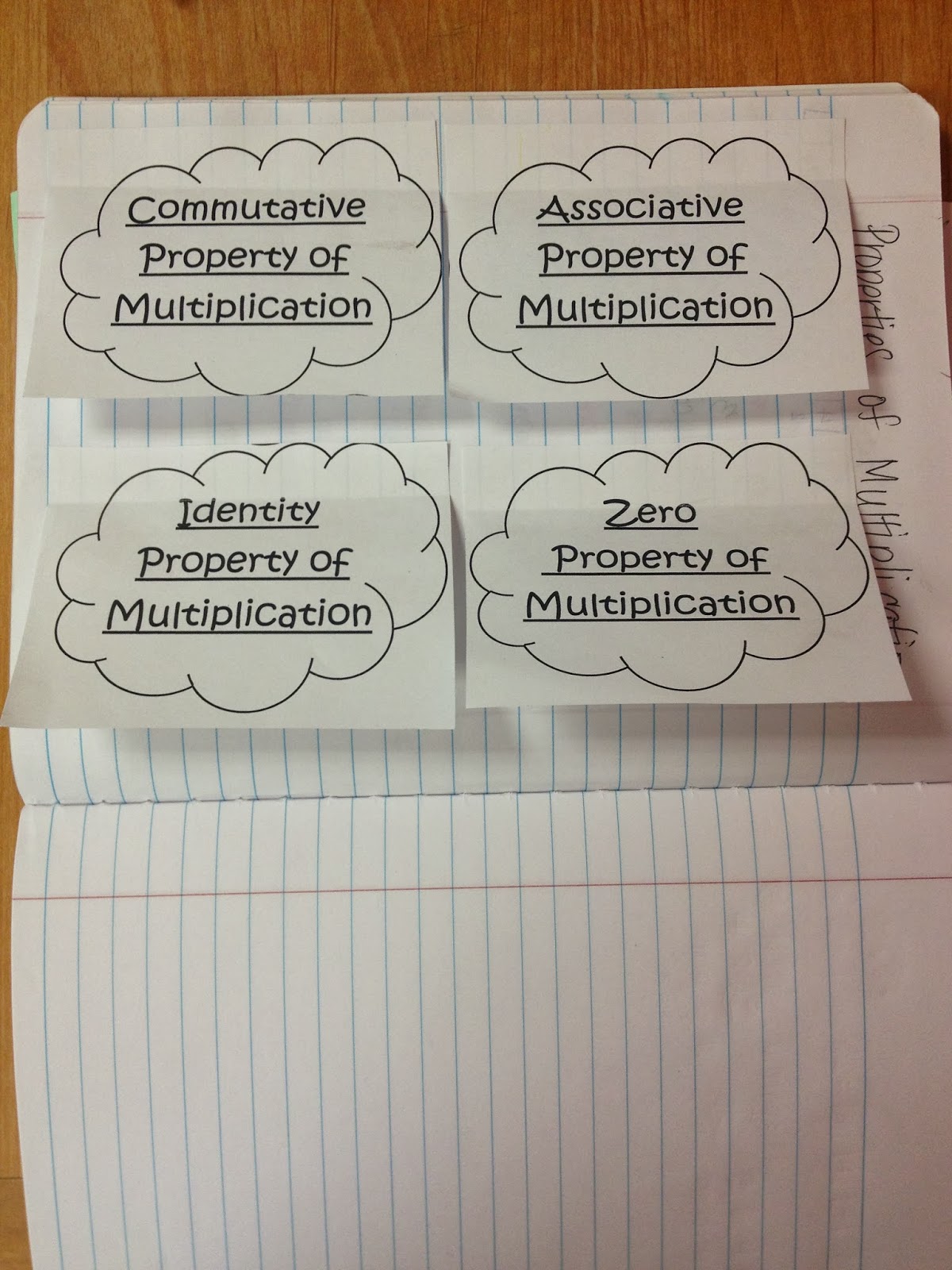
Students learned about the 4 properties of multiplication today. We discussed Commutative Property, Associative Property, Identity Property and Zero Property of Multiplication. Students took the following notes:

 
Students then took turns at their table groups to identify each property of multiplication. I wrote a multiplication fact/property on the board and students held up cards to identify which property I wrote.


Monday, September 23, 2013

Multiplication: Notes and Making Arrays

Monday, September 23, 2013
Today students studied the meaning of multiplication. We took notes that included ways to show multiplication:


Students also used color tiles to create arrays from multiplication facts that I showed them on the board.


Here is a copy of tonight's Homework (due Wednesday 9/25, click to download)... just in case you weren't able to obtain it from the database.

Sunday, September 22, 2013

Subtracting Across Zeros & Adding and Subtracting Decimals

Wednesday, September 18, 2013
Students learned how to subtract in situations involving zeros. They had to go all the way to their "neighbor" that had a value to borrow. We watched the following video to help students understand subtracting across zeros:

 
Students need to be careful when borrowing (regrouping). I have noticed that sometimes students borrow from the thousands or hundreds and give it to the ones place. Students forget to go place value by place value to give and borrow.
 
 
Thursday, September 19, 2013
Students learned how to add and subtract decimals using models and by lining up the decimal points.


 Students also wrote addition and subtraction clue words in their math journals.


All grades are updated on the grade book/database. I have uploaded Friday's test scores on the grade book as well. Please have a look.